Coffee & Conservation: Our Costa Rica Guide’s Secret to Sharing the Pura Vida

“Pablo is a simple person who likes simple things, but with an open mind to learn about life.”
That’s how our Costa Rica guide Pablo Ledezma introduces himself, though Exodus travelers quickly discover there’s much more to him.
He’s a coffee lover, a conservationist and a lifelong learner who spends his spare time reading everything from politics to cooking. It’s a combination that has shaped how he sees the world, and one that has made him one of the best guides in Costa Rica.
Pablo didn’t always plan to be a tour leader. At first, he studied business administration and worked in a US company. Two years in, he discovered he wanted more from life.

“That’s not for me – being between four walls and following a schedule. That’s not my life.”
He changed direction, studied tourism (with a specialisation in ecotourism) and discovered work that felt like him.
“You can make mistakes in your life, but you have to learn from them. You have to walk where you feel better. For me, guiding was that path.”
An incredible 17 years later, he still treats every trip as if it’s his first.
He admits: “I still feel nervous [before each trip]. I have to read people. I have to connect with them. But that is what makes it beautiful.”
Travelers describe him as thoughtful and knowledgeable – a great leader – but also someone who knows when to joke and when to be serious.
Safety comes first (“that’s one of the most important things, especially when leading a group”), but there are always moments to make jokes.
And once the day slows, “we talk as a family, around the table at dinner or lunch. That’s the way I like to be, near to people.”
Read more: 5 Great Reasons to Visit Costa Rica During the Lesser-Known ‘Green Season’
The Flavours of Costa Rica
Food – and coffee – is often his favorite way to introduce travelers to his country.
“I really love coffee culture. I like to explain the history of coffee production in Costa Rica,” he says. “I try to connect everything – the history, economy, the local production, the benefits coffee brings to families, even the way it shaped Costa Rican history.
“At the same time, the different kinds of coffee we produce give different tastes, and people can try them all. I’m a coffee lover, and I think people take that love with them.
“At the end of my trips, coffee is what my travelers take home the most, because they then love it as much as I do!”.
Meals and markets give him ways to connect groups with local life – and surprise and delight travelers.
“If you are in my group, you’re gonna try everything – fruits, dishes, vegetables, snacks.”
At fruit stalls, he lets travelers taste and compare all the different types.


“People love it, because they connect with the people selling fruits in the streets. At the same time, they see the different colours, the different textures, the different flavours. At the end of the trip, they are thankful for that experience.”
He also enjoys showing guests the Central Market in San José. “Sometimes I have to pick people up from the airport and if they arrive early, I like to take them to the market to show the different dishes and the products we produce: agriculture, fish, beef, everything.
“Of course, I take them to the coffee station, one of my favourites. A friend of mine roasts the coffee right in front of people. It’s a really nice experience.”
Conservation with Purpose
Conservation runs just as deep. Pablo reflects on the kind of travelers he often sees exploring Costa Rica.
“I don’t think there are plastic tourists or fast-food tourists in Costa Rica,” he says. “People who come here want to know the culture, be respectful, and learn.”
For him, ecotourism is about a circular economy. “I try to teach people that you can grow as a country, but at the same time you can keep your natural reserves in a very good way, right? That means looking at society, economy, and nature together – the three pillars of sustainability.”
Just the day before this interview, he had finished leading a tour that visited an organic pineapple plantation. “We showed how production works in an organic way and how it can work in an industrial way. People can see the difference. If you go to the organic family farm, they’re gonna teach you. And you support the family. So that’s when you are traveling with purpose, right?


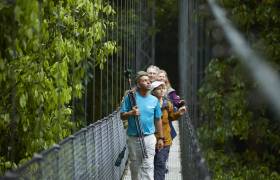
There are many conservation projects across Costa Rica, and Pablo appreciates how Exodus integrates them naturally into itineraries.
“Something really good with the Exodus trips in Costa Rica is that they visit many different communities, villages, and national parks. We’re a pretty small country, and in such a small country every little community is different. We have many cultures, so every place is totally different. In each place, I like to show a dish from the area, how people live, even the way they build their houses.
“For example, in the area of La Zona de los Santos (the central, mountainous region of Costa Rica), we visit a lady in her home who always prepares beautiful dishes for the group. But the good thing is the way she explains, in a very simple way, as a farmer, how she uses resources and doesn’t waste anything. She keeps a good economy in a very rural area. That’s one of the things I like about Exodus – they invite people to know families that work in a sustainable way.”
Pura Vida and Pablo’s Favourites

Pura vida comes up quickly in his conversations too. “That’s the country of Pura Vida. That is an expression we always use. It means pure life. It’s a very usable word in Costa Rica. We adopted it in the 1970s, but nowadays it’s a way of living.”
He adds: “If people want to disconnect from the world, this is the right place. If you want to disconnect from stressful life, from politics, from economics, and go in a slow way – that’s Costa Rica.”
La Fortuna is one place that captures this spirit. It’s the gateway town to Arenal volcano, one of Costa Rica’s most iconic peaks, famous for its natural hot springs, waterfalls, and adventure activities.
“Usually, it’s rainy and cloudy when we arrive, so you don’t see much,” says Pablo. “But then in the morning, suddenly the clouds move and you see the volcano. It’s stunning every time. I’ve been there hundreds of times, but it always feels special.”


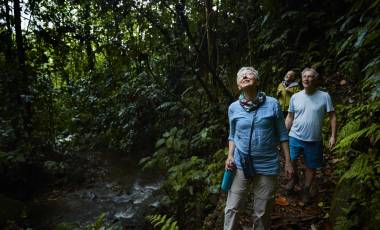
Another of Pablo’s favourites is Corcovado National Park, on the Osa Peninsula. The region is often called the most biologically intense place on Earth, home to jaguars, tapirs, scarlet macaws, and four species of monkey.
“In just a small area, you have three percent of the world’s biodiversity. You can walk kilometres of beach with no buildings, just forest and wildlife. You can even have a beach all to yourself.”
On nearby Caño Island, he’s seen turtles feeding on reefs, and whales and dolphins alongside the boat. “The island is considered one of the best spots in Costa Rica for snorkelling and scuba diving. It’s one of my favourites.”
Learning and Lasting Bonds

Reading underpins his guiding style. He reads widely, everything from history to politics to cooking. “Reading makes me patient to learn. That’s the point.”
It also gives him ways to connect ideas for travelers – explaining how politics shaped history, how culture shaped cuisine, or why each small region has its own traditions.
By the end of a trip, Pablo says his groups feel like family. “People you met just 15 days ago feel like family,” he explains. And these connections can be for life. He mentions some travelers from a trip ten years ago still call him every Christmas. “That’s the most beautiful thing.”
Pablo sums up Costa Rica in one last thought: “At the end we are just humans trying to learn about many things. And Costa Rica is a very good place to learn.”