The Hidden Side of Peru: A Local Guide’s Perspective
There are guides who know a place well, and then there are guides who belong to it. Our Peru guide Edwind Colque is firmly in the latter camp. Walk the Inca Trail with him, and you don’t just move through the Andes – you begin to understand them through the eyes of someone who feels part of the mountains themselves.
For him, guiding isn’t simply a profession. It’s heritage, memory, language and landscape rolled into one. And for travellers, that depth of connection is exactly what turns a great trip into something transformative.
Ask Edwind what he loves most about guiding, and he doesn’t hesitate.
“In this job, you make friends for life. I love the mix of people I travel with; everyone is so inclusive. Some are from Wales, Ireland, Canada, the United States, and Japan, and they all have incredible stories to share. To make those kinds of connections on a daily basis makes my days so much richer. ”


He makes a concerted effort to set the tone at the beginning of every trip he leads.
“The first meeting, the icebreaker, is the most important moment for me,” he says. “That’s where I see who the people are, what kind of experience they’re looking for. From there, little by little, I can start to show them the important things about my country.”
That sense of shared discovery runs through everything he does. Edwind doesn’t see himself as someone simply leading others from point A to point B. Each trip is a journey he’s still enjoying himself – even after years on the trail.
“I don’t see it as a job anymore,” he explains. “Every trip is my journey as well. I get out of my hometown, I visit these places again, and I enjoy the experience.”
Edwind was born in the Peruvian Amazon, near Iquitos, where his parents were working at the time. But Cuzco is where his story really begins.

“When I was two or three, my family moved to Cuzco, and I’ve lived here ever since,” he says. “I fell in love with every single thing in this city.”
Home, for him, isn’t just geography. It’s culture, community and language. His mother tongue is Quechua, learnt first from his grandparents and practised at home.
“As a kid, it was hard,” he admits. “I couldn’t pronounce everything properly, and some friends made fun of me. But later they understood. This language is powerful. It connects me to my community and to my ancestors.”
Today, speaking Quechua isn’t a novelty – it’s a living link. It helps him move easily between worlds: between travellers and local communities, between ancient history and modern life. And it’s part of what makes his guiding feel so grounded.
“To be Quechua is one thing,” he says. “But to be part of the Andes – that’s another thing entirely. I’m a Highlander. I’m not a city boy. I feel connected to nature. When I’m walking in the mountains, I know this is where I belong.” He adds, “Once you spend time in this place, something always calls you back.”
“When my groups are in the Andean mountains, I tell them: open your mind. Walk, look, listen,” he says. “Not everyone gets the chance to feel this kind of connection to the land.”
On the trail, Edwind’s Peru is equal parts big moments and small ones: the iconic sites that live up to the photos, and the everyday details that make you feel like you’ve stepped into someone’s real life.
For him, Andean culture isn’t something frozen in the past or confined to museum labels. His culture is still threaded through what people eat, wear, farm and celebrate.


“Culture isn’t just telling history,” he says. “It’s living traditions. It’s how people dress, how they farm, how they build, how they respect the land.”
On our trips through the Sacred Valley and along the Inca Trail, he explains why settlements were built where they were – often in places that seem improbably remote.
“The Incas chose these places because they believed they had good energy,” he explains. “They wanted to be connected to nature. And they respected Pachamama – Mother Earth – in everything they did.”
That respect is still visible today, from agricultural rituals to seasonal celebrations tied to the solstices. Understanding astronomy wasn’t abstract knowledge for the Incas; it was essential to survival. “Agriculture was everything,” Edwind says. “They needed to know when to plant, when to harvest, how to feed the people. In many settlements, I feel the presence of my ancestors.”
“I always follow the programme,” he says. “But between point A and point B, there’s a gap. And that’s where extra experiences can happen.”

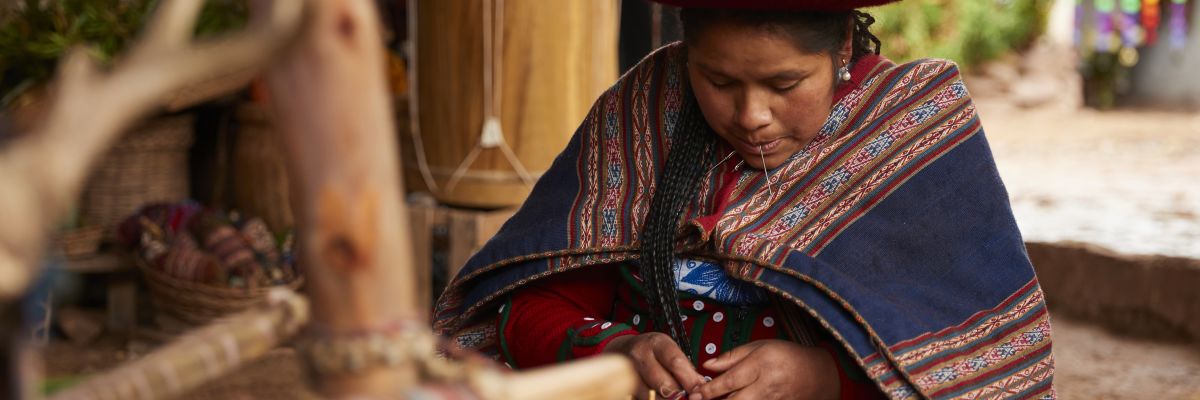
That might mean stopping to explain why women in a village are wearing a particular style of dress, or ducking into a simple home to see a traditional kitchen that’s changed little over generations.
“These are things you won’t see written in the itinerary,” Edwind says. “But they’re highlights. They’re uncommon.” Sometimes, if you’re lucky, it might even include being invited in for a drink of chicha – a traditional corn beer and a sign of local hospitality.
“I like to show a side of the Andes that not many people have the chance to see,” he says. “Those are the moments people remember most.”
Food is another way Edwind introduces travellers to Peru. “Peru is rich in food,” he says, “You can expect big flavours, big colours and excellent presentation. It’s a fusion of Andean ingredients and colonial influence.”
From quinoa and corn to classics like ají de gallina and lomo saltado, meals are generous, colourful and designed to be enjoyed slowly.
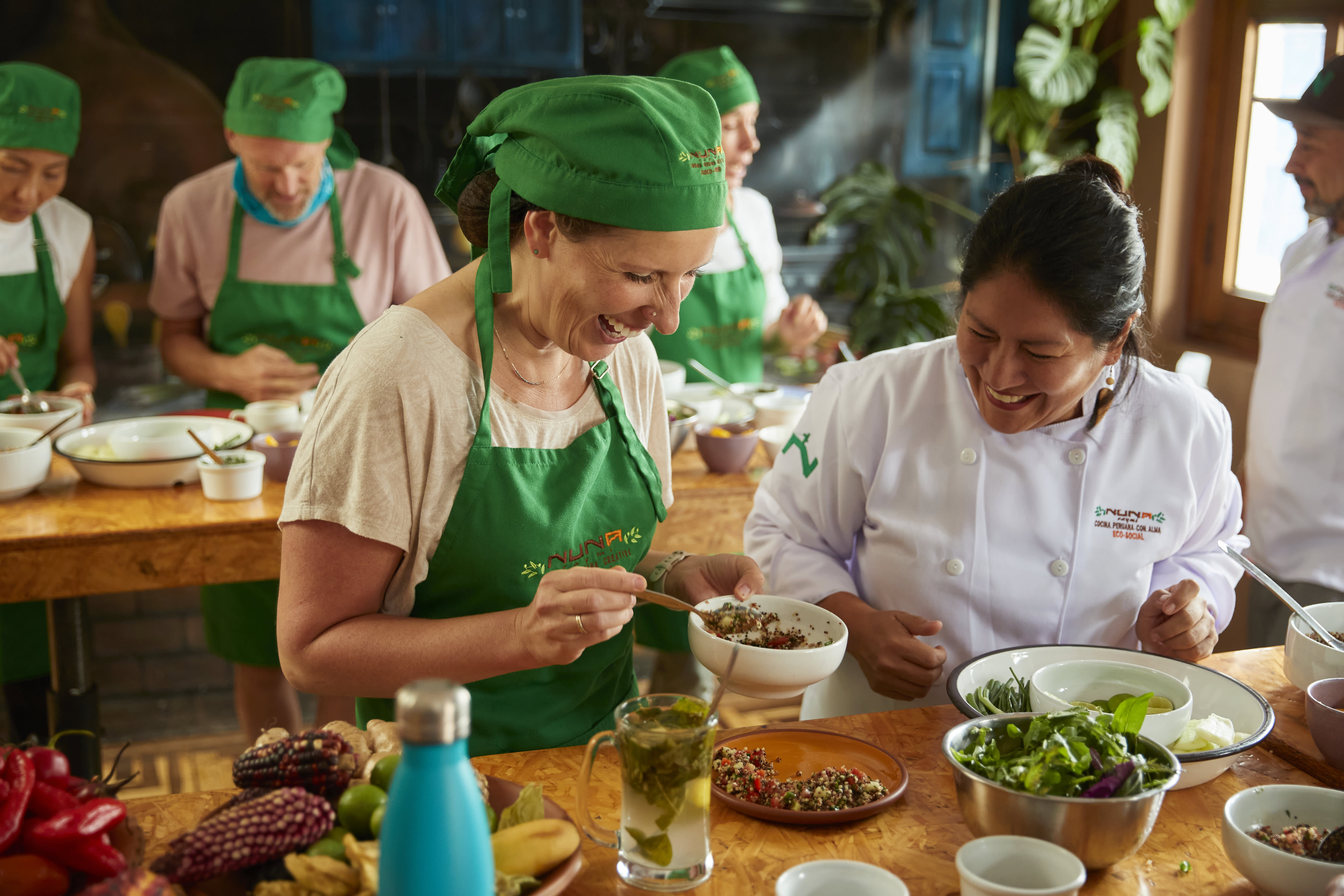
“We say you eat first through the eyes,” Edwind explains. “Then you enjoy the flavours.” A good meal becomes a cultural lesson, a moment of pure pleasure, and a core memory all at once.
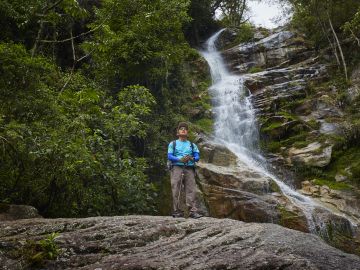
The trails themselves are varied – stone staircases built by the Incas, flatter jungle paths, misty mountainous sections, where views appear and disappear with the clouds.
“It’s different from the photos you see online,” he says. “When you walk it, it’s another level.”
Becoming an Exodus tour leader was daunting at first. Edwind was young, surrounded by experienced guides, and he remembers how that felt. But reassurance came quickly.
“They told me: you are the one who lives this,” he says. “No one can explain your country like you can.”
That sense of responsibility and honour still shapes how he guides today.
“To share this land, these traditions, this culture with people from all over the world – that’s something I’m proud of. It’s my world, and I love showing it. ”

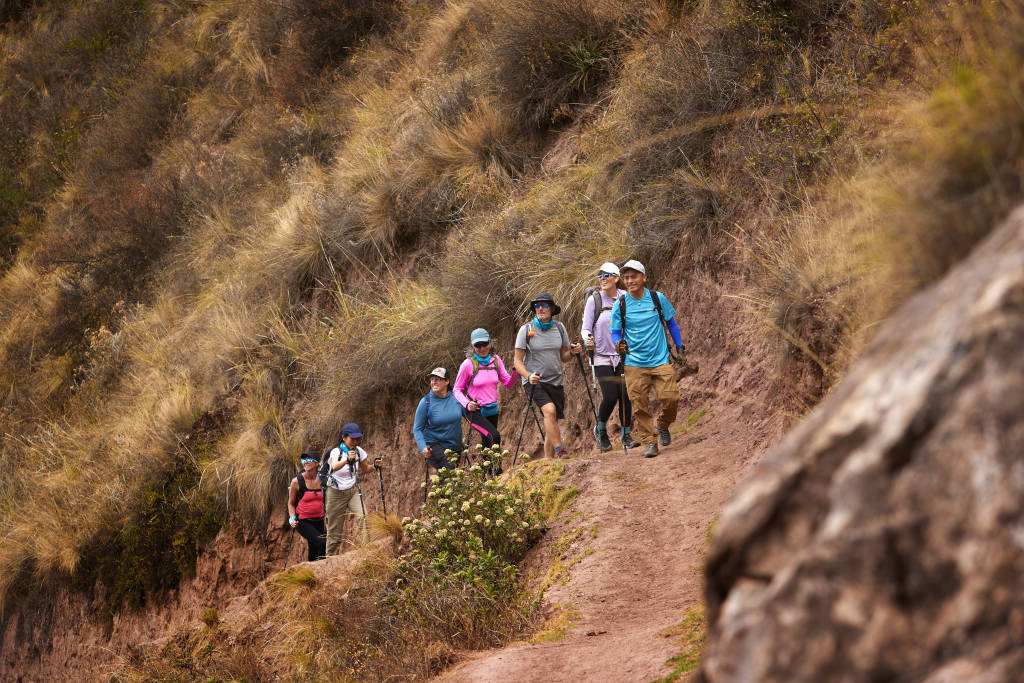
Travel with Edwind in Peru, and you’ll see the big-hitters – Cuzco, salt pans, Inca stonework, that first glimpse of Machu Picchu – but you’ll also get the quieter, human moments that don’t always make it onto the magazine. The pause at the local huts. The story behind a tradition. The feeling, now and then, that the mountains aren’t just part of the scenery – they’re part of something older, deeper and very much alive.