Current as of: October 24, 2026 - 02:56
Rajasthan Highlights by Bike Trip Notes
- Ways to Travel: Guided Group, Superior
- Destination: India
- Programmes: Cycling
-
Activity Level:
4 out of 7 - Moderate & Challenging
- 12 Days: Land Only
- Ages: 16+
- Trip Code: MIL
Trip Overview
Cycle Rajasthan’s backroads, from Pushkar to the Taj Mahal, with tiger tracking in Ranthambore
Ride quieter rural roads deep into Rajasthan, witnessing the ‘Land of Kings’ at its most majestic. Along the way, our local tour leader provides unrivalled insight into each day – from Jaipur’s early-morning rituals to lesser-known countryside stops that are easily missed without their expertise. Staying in former palaces and forts reveals the region’s royal past, while a safari in Ranthambore offers the chance to spot Bengal tigers in their natural habitat. The journey culminates at the Taj Mahal, explored at sunrise when the crowds are thinner and the World Wonder bathes in a soft morning light.
Is This Trip for You?
This trip is rated Activity Level 4 (Moderate & Challenging). For more information on our trip gradings, visit our Activity Level Guidelines page. If you have any queries about the difficulty of the trip, please contact us.
- Bike: The included bike for this trip is a fully serviced mountain bike
- Cycling days: 8
- Average distance: 39mi (63km) per day with full vehicle support
- Terrain and route: 95% paved, 5% partly unsurfaced rural roads
Suitability: Traffic in India can be busy with limited enforcement of the rules. Inexperienced riders may find this difficult, but your tour leader is an expert on navigating these conditions and will brief you on how to cycle safely in India. Please listen carefully and follow the instructions.
Climate: It can be hot and humid in India, particularly during September-November and March-May, which can increase the difficulty of the cycling.
Monuments: The Archaeological Survey of India (ASI) is responsible for the conservation of many monuments in India, including the Taj Mahal, and very occasionally this may mean work is taking place at sites visited on this trip. The ASI schedule is never published so it is not possible to forewarn when work will be taking place.
Festivals: Some departures coincide with Holi and Diwali. These can be local celebrations within communities and families and are not necessarily marked to the same extent throughout the country. We will seek opportunities to see the festivities; however, we cannot guarantee what will be happening in the local area during the trip.
Cycling safety: Your safety is our number one priority. The Exodus Safe Cycling Guide explains how we will keep you safe throughout your trip. We also ask for your support by following the guidance and recommendations outlined in the guide.
Group
Our local team of leaders has proved very popular with their incredible knowledge, passion and hospitality adding greatly to the experience. There is no better way to experience Indian culture than letting a local guide show you around their country. Depending on group size, there may be one or two cycling leaders.
Adult min age: 16
Min group size: 4
Max group size: 16
Itinerary

Land Only
- Start City: Delhi
- End City: Delhi
Land Only Itinerary
Adventure starts in Delhi
Begin your adventure in pulsating Delhi. It’s a city split in two, with historic Old Delhi in the north and the nation’s capital, New Delhi, in the south.
Around 6pm, say namaste to your tour leader and fellow travellers, when we gather as a group for the first time to get to know each other and learn more about the adventures ahead.
Your tour leader then ensures a big welcome by arranging a group dinner.
Want more time in Delhi? Secure pre-tour hotel nights through your sales representative
Accommodation: Hotel Regent Grand (or similar)
Ride the rails to Ajmer • To Pushkar • Visit Brahma Temple

We’re off to New Delhi Railway Station, where we catch the 6.10am Shatabdi Express train to Ajmer, arriving early afternoon. The route passes through towns and open fields, and our tour leader provides us with snacks and refreshments along the way.
Upon arrival, we transfer (30 minutes) to our Pushkar hotel. After check-in, we set up our bikes and take a short orientation ride, cycling through peaceful countryside and flower farms. Along the way, gain insight into local agricultural practices and visit community-led gooseberry (amla) orchards, where we can interact with farmers and learn about their traditional cultivation methods.
In the evening, we walk around Brahma Temple, among the very few temples dedicated to Lord Brahma, then explore Pushkar Bazaar, where our tour leader leads us through the lively narrow lanes and introduces us to the vendors.
We stay tonight in a grand heritage-style property, designed to reflect the elegance of 19th-century Rajasthani palaces and regarded as one of the best hotels in Pushkar.
Accommodation: Hotel Jagat Palace (or similar)
Pedal into rural Rajasthan • Relax like a royal in a former palace
Our cycling begins properly today as we ride out of Pushkar and into the Rajasthan countryside. Dry riverbeds, fields and village roads set the tone for the days ahead, giving us an early feel for life beyond the cities.
Later, we pass through an ancient bazaar, offering a rare glimpse into traditional trading life – reminiscent of Old Delhi, but on a much smaller, more intimate scale.
Reaching the historic village of Roopangarh, we settle into our hotel: Roopangarh Fort, an elaborate fortress constructed in 1648 for the Maharaja Roop Singh of Kishangarh.
Accommodation: Roopangarh Fort (or similar)
Cycle to Jobner • To Jaipur, capital of Rajasthan
We’re back on our bikes, continuing through rural Rajasthan to the town of Jobner on village roads and dirt tracks.
Our first stop is a family home, where we take a tea break and enjoy a warm interaction with the household.
Later, we visit Sambhar Lake, the largest inland saltwater lake in India. The landscape is vast and open, with seasonal water bodies and small irrigation tanks (talabs). We cycle along parts of the lake, taking in this striking environment.
Finishing our ride, we transfer (1hr 30min) to Jaipur, the capital of Rajasthan. The contrast is immediate: after quiet roads and open countryside, we arrive in one of India’s most carefully planned historic cities.
Accommodation: WelcomHeritage Traditional Haveli (or similar)
Explore Jaipur as it begins to wake • Marvel at Amer Fort • Dive deep into the bazaars

Start early to explore the Pink City as it wakes: expect morning temple visits, shops opening, and daily life beginning. Our ride takes us through the flower and produce markets and to Govind Dev Ji Temple, one of the most important Krishna temples in the city.
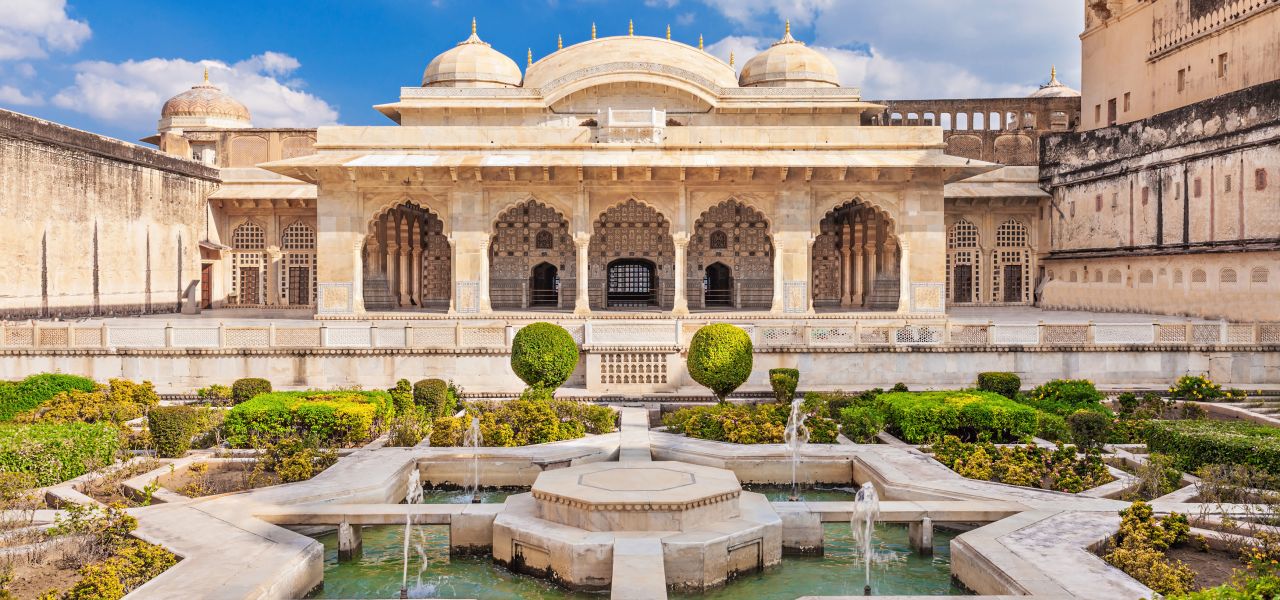
Returning to the hotel for breakfast, we then transfer to Amer Fort to explore the glorious blend of Rajput and Mughal architecture found at the 16th-century hilltop stronghold. After, we head into Jaipur’s bazaars, where our tour leader helps cut through the noise and shows us how each bazaar specialises in a different industry.
Accommodation: WelcomHeritage Traditional Haveli (or similar)
Ride via Ramgarh Dam • To the ancient city of Dausa
Today’s route leads us through farming villages and open countryside to Ramgarh Dam, a human-made reservoir that once acted as a major water source for Jaipur.
After, we stop to explore the historic Hindu temple of Jamwai Mata Mandir, before finishing outside the ancient city of Dausa – named after the Sanskrit word dhau-sa, meaning beautiful like heaven.
We then transfer (45 minutes) to our accommodation for the night, a heritage hotel whose foundations stretch back to the 11th century.
Accommodation: Bhadrawati Palace (or similar)
Push on to Talabgaon Castle
Today is one of our longest rides of the trip, but one that takes us through hamlets, farmland and small settlements. We visit the Ram Janaki Temple, a peaceful, photogenic stop where we can explore and take pictures.
The landscape changes gradually as we make our way to our accommodation for the night: Talabgaon Castle, a beautifully restored 200-year-old fort.
Accommodation: Talabgaon Castle (or similar)
Ride to Khirini village • Tiger safari in Ranthambore National Park
Bid farewell to our fort-hotel and continue pedalling through the countryside. Our ride takes us to Khirini village, passing through quiet rural roads where we can see everyday life – homes with livestock, farmers at work, and local people going about their daily routines.
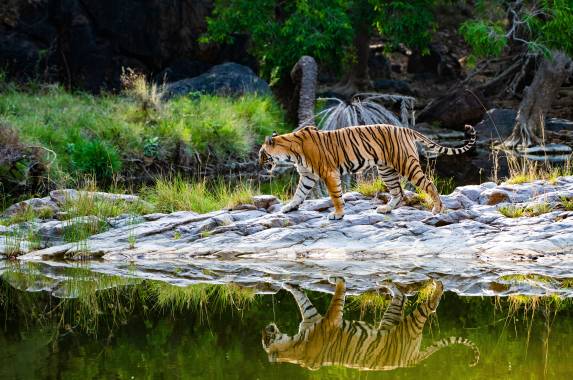
We stop for lunch before transferring (45 minutes) to our hotel in Ranthambore, where our transport is waiting to take us for an afternoon safari in search of Bengal tigers.
There are at least 70 tigers in the national park, meaning a relatively high density and a better chance of spotting them.
We take a shared ride in a purpose-built safari vehicle, known as a canter, and are accompanied by a forest guard – a skilled tracker who greatly enhances the wildlife viewing with their keen eye and knowledge of tiger behaviour.
Accommodation: Hotel Tiger Den (or similar)
Ride to Karauli
Leaving the hotel, we ride along the outskirts of the national park, keeping our eye out for wildlife in the distance. Today’s route offers a rewarding mix of nature, rural life, and heritage, as we cycle through countryside and traditional villages.
Along the way, glimpse into everyday life in rural Rajasthan, passing mud-brick houses, women dressed in vibrant ghagra, and traditional wells and hand pumps still in use. As we approach the Chambal River region, we may spot reptiles such as gharials and mugger crocodiles, with time to pause for photos.
Our journey ends in the historic city of Karauli. If time allows this evening, your tour leader can take you to explore some of the highlights, including the 14th-century City Palace, set among winding streets filled with shops selling lacquer bangles and local handicrafts.
Rest tonight at a charming heritage hotel set within peaceful gardens, offering warm hospitality, and a glimpse into Karauli’s royal past.
Accommodation: Bhanwar Vilas Palace (or similar)
Cycle to Bari • To Agra
We spend our final cycling day moving through rural landscapes to the city of Bari, riding out of town with views of Karauli Fort, which sits high on a hill.
This day offers excellent village riding, passing through quiet rural roads where we can observe everyday life.
Upon arrival in Bari, we transfer (two hours) to Agra, home of the Taj Mahal.
Accommodation: Taj Vilas (or similar)
Visit the Taj Mahal at sunrise • Return to Delhi

This morning is one to remember! Wake early to visit the Taj Mahal at sunrise, when the white-marble exterior is illuminated by the soft early light, the crowds are smaller and the birds chatter among themselves.
After admiring it from the outside and enjoying a deep dive into this New World Wonder from our tour leader, we head inside, with a chance to explore the beautiful inner chambers and mausoleum.
After we’ve fully soaked in the magnificence of the Taj Mahal, we transfer (four hours) back to Delhi, where our groups typically enjoy a final group dinner together – a chance to relive the moments we’ve shared.
Accommodation: Hotel Regent Grand (or similar)
Adventure ends in Delhi
You’ve ridden through the Rajasthan countryside, tracked tigers in Ranthambore and stood before the Taj Mahal at sunrise, but now it’s time to begin your return journey home.
Alternatively, if you’d like to extend your adventure, speak to your sales representative to discuss our large range of extension options.
Accommodation

We aim to secure locally owned accommodation that is well located, offers good value for money, and plenty of comfort.
The normal hotels used are found on the daily itinerary; however, below are some of the standout accommodations on this trip.
Roopangarh: Roopangarh Fort (night 3)
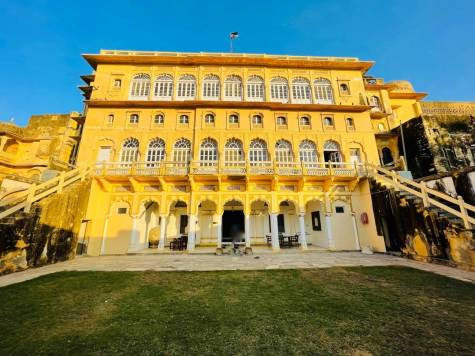
Spend the night within the walls of a 17th-century fort, where sweeping views stretch across the surrounding plains. Rooms retain period features with carved details and antique-style furnishings, while terraces and quiet courtyards offer space to relax after a day travelling through rural Rajasthan.
Dausa: Bhadrawati Palace (night 6)

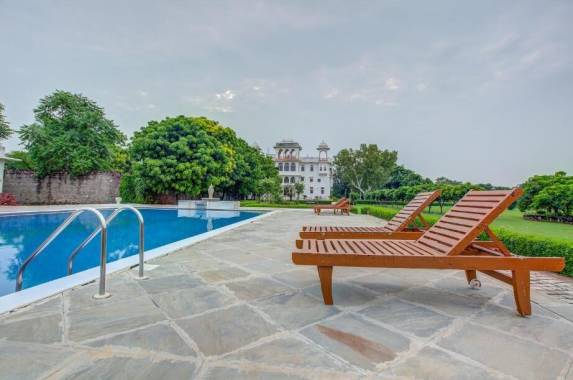
Unwind in a peaceful heritage stay set within landscaped grounds near Dausa. Built in a traditional palace style, the property combines ornate design with modern comfort, while spacious rooms and a swimming pool provide a welcome place to relax between visits to nearby forts and stepwells.
Karauli: Bhanwar Vilas Palace (night 9)

Bhanwar Vilas Palace is a charming heritage retreat set in lush gardens, with antique-filled interiors and a pool, offering warm hospitality and an authentic glimpse into Karauli’s royal past.
Worth knowing
- Tailor your trip: Extend your adventure by securing extra hotel nights before or after the main itinerary. Speak to your sales representative to book.
- Private rooms: Like most tour operators, we room solo passengers together. If you’d prefer to have a private room, it’s normally possible to do this for a supplement. Speak to your sales representative to book.
- Heritage properties: Our accommodation comprises a number of historic buildings. Due to their age and the need to preserve original heritage features, maintenance standards may differ from those of modern properties. As a result, some wear and tear should be expected.
Single supplement from USD 1077
Food & Drink
Allow at least 1,400-2,400 rupees (US$20-US$35) per day for lunches and dinners not included.
In most towns, there is a good selection of restaurants and a choice between Indian and Western cuisines. If you are vegetarian, India is probably one of the best destinations to travel to with a wide range of dishes on offer. Tea and soft drinks are very cheap. A large bottle of beer is approximately 330 rupees (US$4). Mineral water is widely available.
Transport
Most of our exploration is by mountain bike, plus we have transfers where needed. We also take the train (the Shatabdi Express) from Delhi to Ajmer.
Weather & Seasonality
October to March is the ideal time to visit northern India. Days are normally warm to hot and nights cool or mild. Humidity is very low and little or no rain falls. In March, April and October, it can get very hot during the day. Evenings in Delhi can be surprisingly cool, so bring warm clothing plus a sun hat, sunscreen and sunglasses. It gets very cold in the early mornings and evenings between December and February.
Joining Instructions
Key information
Start hotel: Hotel Regent Grand, 2/6, Pusa Rd, opposite Metro Pillar No. 167, Block 2, East Patel Nagar, Karol Bagh, New Delhi
Phone: +91 11 4601 1111
Recommended arrival time: There will by a welcome briefing with your tour leader around 6pm
Airport: Indira Gandhi International Airport (DEL)
Getting to the start hotel
The start hotel is approximately 25 minutes’ drive from the airport. We provide one group transfer from the airport to the hotel, which you can join at no extra cost, provided you can be at the airport before the transfer leaves. Speak to your sales representative for the transfer times or to arrange a private transfer.
Catching your return flight
There’s one group transfer to the airport, which you can join at no extra cost. Please speak to your sales representative for the time of the transfer. If the group transfer does not suit your flight time, speak to your sales representative to arrange an alternative.
Full joining instructions including local emergency numbers will be sent to you as part of our Final Joining Instructions. If you do not receive these at least a week before departure, or require them earlier please contact our office or your travel agent.
Location start: Delhi
Location end: Delhi
What To Take
Essential Equipment
- Insect repellent
- Light cotton trousers (pants)
- Lightweight long-sleeve shirt
- Sun hat
- Sunscreen
- Sunglasses
- Energy snacks
- Refillable water bottle/water bladder (also known as a hydration pack/CamelBak, which are useful for rehydrating on the go)
- Buff (for dusty areas – or face mask if preferred)
- Cable lock, or small chain and padlock, to lock your bag up on the train
- Good set of warmer leggings/tops for cold cycling mornings; this is particularly required on winter departures
- Take a thick pullover or fleece and warm trousers (pants) for the game drive. Also bring long-sleeved, neutral-coloured clothing. This helps prevent mosquito bites and improves your chances of seeing game animals, which are scared of bright colours
- For some monument or temple visits, clothing should cover shoulders and be on or below the knee. In general, women especially should consider dressing conservatively to avoid unwanted attention and not to cause offence
Optional Equipment
- Face mask: air pollution is high in Delhi during November (but also occasionally at the end of October and beginning of December)
Face mask: air pollution is high in Delhi during November (but also occasionally at the end of October and beginning of December)
Equipment Hire
Included standard bike
For this trip, we use fully serviced mountain bikes. We will take your height at the time of booking to reserve equipment. If you have a preferred bike size, please request when booking.
Bringing your own bike
If you’d prefer to bring your own bike, please advise us at the time of booking and you will receive a discount on the price of the trip. However, you will be responsible for any extra baggage charges; assembling and disassembling your bike; and bringing along spare parts and any tools specific to it. You should also ensure you have adequate insurance to cover loss, damage or theft.
Cycle Accessories
Bringing equipment from home
You’re welcome to bring your own equipment, such as SPD pedals or clipless pedals, your own saddle (excluding the seat post), or gel saddle cover for the hire bikes. Your leader will help you fit these when bikes are distributed.
Helmets
Helmets are mandatory for everyone on a guided Exodus cycling trip. You must bring your own as, following best safety practice, they are not available for hire.
Cycling clothing
For all cycling trips we recommend:
- Padded cycling shorts: For destinations with more modest cultures, we also recommend loose ‘over-shorts’ for riding or rest stops
- Eyewear: Either sunglasses or eye protection with clear lenses to protect the eyes while riding
- Cycling gloves: Especially for riding off-road or on rugged surfaces
- Cycling shoes: Cycling is more efficient with stiff-soled shoes. We don’t recommend open-toed shoes or sandals
- Small close-fitting backpack or bum bag (fanny pack): To keep spare clothing or essential items to hand during the ride
Prohibited items to travel with in India
- The Indian government has banned e-cigarettes and related products. You can’t buy e-cigarettes in India or bring them into the country. Please ensure you do not pack these in your luggage.
- Satellite communications devices, for example (but not exclusively) Garmin inReach or any other brand GPS tracking device, are illegal in India without a license. Please do not bring them with you.
Practical Info & Visa
Visa
India
To avoid possible problems at immigration, make sure your passport is valid for a minimum of 180 days at the time of entry into India.
Travellers from the UK, US, CA and EU normally need a visa to enter India. Please note, visa requirements often change and it is your responsibility to obtain any required visas for this trip. Therefore, we recommend that you check with the nearest embassy or consulate of your chosen destination(s), including any countries you may be transiting or transferring through.
Some local governments provide guidance on what visas their citizens need. To help, we’ve gathered a selection of useful links below.
• Australia: www.smartraveller.gov.au/destinations/asia/india
• Canada: www.travel.gc.ca/destinations/india
• United Kingdom: www.gov.uk/foreign-travel-advice/india/entry-requirements
• USA: www.travel.state.gov/content/travel/en/international-travel/International-Travel-Country-Information-Pages/India.html
Travellers eligible for an e-visa, which includes those from the UK, US, CA and EU, can apply at www.indianvisaonline.gov.in/evisa/tvoa.html.
For more information on applying for your Indian Visa, including details required for your start hotel and local reference contacts, please click on this link: Indian Visa Information.
New Digital Arrival Card: Travellers from the UK, US, EU and Canada must also complete a Digital Arrival Card. This can be filled online up to 72 hours before arrival via the official Indian visa website https://indianvisaonline.gov.in/earrival/. This is separate from the Indian e-visa process and this remains the same. Physical cards will remain at the arrival airport until 1 April 2026, at which point the Digital Arrival Card will be made mandatory.
Self-declaration form requirement: All international passengers arriving in India are currently required to complete the Air Suvidha Self Declaration Form before travel, preferably before boarding their flight. The form can be completed up to 24 hours before arrival and should be presented on arrival if requested by local authorities. Complete the form via the official Air Suvidha 2.0 Portal. Requirements may change at short notice, so please check the latest guidance before departure. This additional requirement is currently being taken amid concerns over the ongoing Ebola outbreak and in the interest of passenger safety and public health.
Vaccinations and Health
India
You require a yellow fever vaccination certificate if arriving from a country with risk of yellow fever transmission. Proof of a polio vaccination may also be required by some visitors. Please confirm all requirements and recommendations with your doctor or travel clinic.
You may also want to consider vaccinations for tetanus, hepatitis A, typhoid, cholera, hepatitis B, Japanese encephalitis, rabies and tuberculosis. The risk of malaria is slight, but you may wish to consult your doctor or travel clinic for further advice.
Additionally, dengue fever and chikungunya are known risks in India. Both are tropical viral diseases spread by daytime biting mosquitoes. There is currently no vaccine or prophylaxis available for either, and therefore the best form of prevention is to avoid being bitten. We recommend you take the usual precautions to avoid mosquito bites.
Some of our India trips spend time at altitude. In regions over approximately 6,560ft (2,000m), there is little risk of mosquito-borne diseases. For trips above 9,840ft (3,000m), there is a risk of being affected by acute mountain sickness. Our itineraries are designed to enable everyone to acclimatise to these altitudes, but you should be aware that it is still possible for you to be affected. Please see the Trip Notes for further information.
The risk of malaria on this trip is slight, but you may wish to consult your GP or travel health clinic for further advice.
Middle East Respiratory Syndrome: There is evidence that Middle East Respiratory Syndrome coronavirus (MERS) is spread by contact with camels. This trip may include the option of a camel ride, or it spends time close to camels, which is undertaken at your own risk; we suggest that you visit the Travel Health Pro website which includes information about the virus.
Local Time
India's time zone: Asia/Kolkata (UTC +05:30)
Electricity
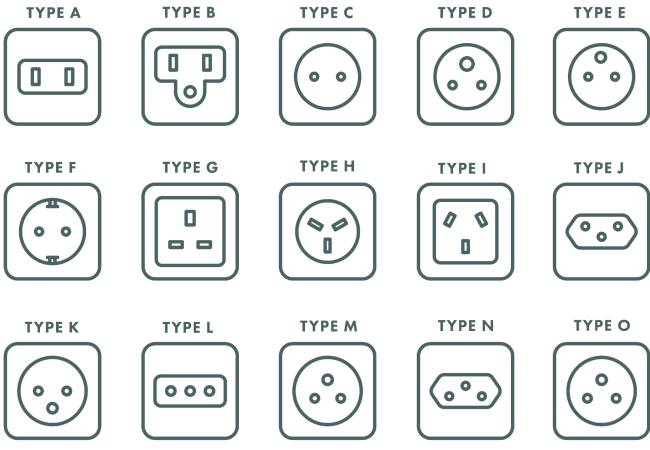
India's electricity:
Plug types C (two round pins), D (three round pins) and M (three round pins) – 230V, 50Hz
Money
India's currency: Indian rupee (INR). Please note, it is illegal to import or export rupees. Do not accept torn or very dirty Indian banknotes from banks or in change as they will almost certainly not be accepted as legal tender in India. You can normally change money back from rupees into US dollars or British pounds at the departure airport, but you must produce an exchange receipt showing that you changed money in India.
ATM Availability
ATMs are widely available in India (Visa and Mastercard are best). However, you should not rely on these 100% of the time, so please take some cash with you. Please inform your bank before departure that you are travelling to India and carry the relevant telephone number with you in case they block your card. You can pay with credit cards in bigger shops all over India.
Money exchange facilities are available on arrival at Delhi international airport, although the rates are not always favourable. You can change US dollars and British pounds in cash outside of Delhi in the main cities.
Extra Expenses & Spending Money
Many sites now charge a small fee for video cameras (handy cams) and you should allow another 740 rupees (approximately US$9) for these. Also allow at least 660 rupees (approximately US$8) per day for personal expenditures, such as soft drinks.
There are endless shopping opportunities throughout this tour and we suggest you take money for souvenirs; even the most shop-shy travellers often succumb to the tempting selection of handicrafts available.
During your trip, it is likely your local guides will take you to emporiums and handicraft workshops. Guides often assume visitors want to shop, it is very much part of the culture, but if you do not wish to go, please make this clear to your guide and Exodus leader at the time. Many people find this a great opportunity to buy local handicrafts, silk, jewellery and carpets.
Tipping
Tipping kitty: Approximately 5000 rupees (US$55) per person
Tips for the leader, drivers and cycle crew are not included in the kitty, and customers own discretion.
Tour leader: Around 6,000 rupees (US$70) per group member
Support staff (driver, helper, cycle mechanic): Around 6,000 rupees (US$70) per group member
Note: For groups with six or more people, you have a second tour leader (or assistant) accompanying the group, so you may wish to top up the tour leader tips to cover both staff. We recommend an extra 3,000-4000 rupees (US$35-US$45) per member
Sustainability and Impact
As a certified B Corp, we’re on a mission to improve our social and environmental impact across all our adventures.
We do this through our innovative Thriving Nature, Thriving People plan.
This ‘nature positive’ approach is designed to help nature and communities thrive in harmony through practical solutions, such as reducing carbon and waste on our trips, supporting conservation projects through the Exodus Adventure Travels Foundation, and rewilding 100 square metres for every Exodus traveller.
You’ll also find Thriving Nature, Thriving People moments across our trips. These experiences are often a highlight of your adventure, while also benefiting the natural world or local communities.
On this trip, we:
- Join an optional Old Delhi tour led by Salaam Baalak Trust guides, supporting former street children through employment while gaining insight into historic neighbourhood life.
Important Information
Your Safe Participation
When booking this trip, you should be confident in your ability to participate in all activities described in these Trip Notes. If you have any doubt about your suitability, please call us and ask to speak to one of the experts on this itinerary.
Although our leaders are well trained to deal with different capabilities, if they have any concerns about someone’s ability to safely take part in an activity, or their impact on other people’s enjoyment, we authorise them to take necessary action which, in some circumstances, may involve asking someone to miss that activity.
By booking this trip you agree to our Booking Conditions which clearly state that our leaders have the authority to do this. In these rare instances we will ensure anyone sitting out is safely provided for and offered alternative options where possible. Refunds will not be provided for activities missed and customers may be liable for additional costs incurred.
Seatbelts
All vehicles used by us should be equipped with working seatbelts, except where approved by us based on the vehicle type or journey. Wherever seatbelts are available, we require our customers to use them for their own safety, even where it may not be a legal requirement.
Travel Safety
For additional information please have a look at the travel safety advice page on our website.
How To Book
Speak to our friendly team of experts to plan your adventure:
- Check availability: our website shows real-time availability of our guided group tours, or contact our team by phone, email or live chat.
- Hold a space: You can provisionally hold a space on any guided group tour to give you time to finalise your travel plans.
- Confirm your booking: Payment of a deposit will complete your booking and secure your place on the trip.
After booking
You will receive a confirmation document and invoice, which includes extra information and guidance about your travel arrangements. Our dedicated Customer Operations team will help you with any pre-travel questions or arrangements and can easily add extensions or extra accommodation to your booking. Final Joining Instructions will usually be sent out two to three weeks prior to departure.
Adding transfers to your booking
If you have arranged your own flights and would like to add transfers to your booking, please provide your arrival and departure details to our Customer Operations team around four to six weeks before departure.
- Where complimentary transfers are included, they are available for any flight but can only be added to your booking once we have received your flight schedule.
- Where group arrival and departure transfers are available, these operate at fixed times. You will need to arrive in time to meet the scheduled transfer. If the timings don’t align with your travel plans, our team can arrange private transfers once they receive your flight schedule.
Trip Note validity
Trip notes may be updated after booking; if any updates significantly impact the inclusions or itinerary you will be advised in writing. A link to the most up-to-date Trip Notes will be sent out with your Final Joining Instructions before departure.
The information in these Trip Notes is given in good faith. All holidays can be subject to unexpected changes, and occasionally it may not be possible to follow the itinerary as planned. In these circumstances we will make the best-possible alternative arrangements that maintain the integrity of the original itinerary.
