Current as of: October 11, 2026 - 23:32
Highlights of Northern Sri Lanka Trip Notes
- Ways to Travel: Classic, Guided Group
- Destination: Sri Lanka
- Programmes: Culture
-
Activity Level:
2 out of 7 - Easy & Moderate
- 12 Days: Land Only
- Ages: 16+
- Trip Code: ASJ
- Carbon Footprint: 25kg CO2e
Trip Overview
Journey from Sri Lanka’s ancient heartland to the cultural landscapes of the lesser-visited north
Travel deep through the central heartland of Sri Lanka and onward to the island’s north – a journey of ancient capitals, rural villages and island communities. Along the way, you’ll climb the rock fortress of Sigiriya for wide views across the central plains, see wild elephants in their natural habitat in Minneriya National Park, then slow the pace with time by the sea in Trincomalee. Further north, days are shaped by temples, forts and daily life around Jaffna, where Tamil culture defines the region.
Is This Trip for You?
This trip is rated Activity Level 2 (Easy & Moderate). For more information on our trip gradings please visit the Activity Level Guidelines page. If you have any queries about the difficulty of the trip please do not hesitate to contact us.
Suitability: This is not a demanding trip, although there are a few long drives with regular stops to break up the journeys. The buses we use are comfortable and air conditioned.
Sigiriya: When visiting Sigiriya Rock Fortress (Lion Rock) the final ascent to the top is on open metal stairs fixed against the side of the rock. There are handrails on either side but those with a strong fear of heights may prefer to stay on the lower level (where the lion “paws” are) and not continue to the rock plateau. You will be able to rejoin the group when they return to the plateau.
Water safety: This trip includes time by a lake, river or sea, where there may be opportunities to swim. You should always seek local advice before deciding whether to swim. Open-water or wild swim spots should be treated with extreme caution. Information on how to keep yourself safe while swimming is shown here.
Group
Our Sri Lankan team of leaders, who we’ve worked with for more than a decade, has proved very popular with their incredible knowledge, passion and hospitality adding greatly to the experience. There is no better way to experience Sri Lankan culture than letting a local leader show you around their country.
Adult min age: 16
Min group size: 4
Max group size: 16
Itinerary
Land Only
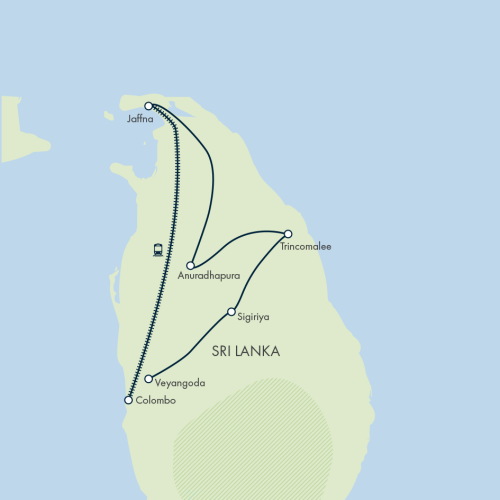
- Start City: Veyangoda
- End City: Colombo
Land Only Itinerary
Adventure begins in Veyangoda
Begin your adventure in Veyangoda, a 30-minute drive from Sri Lanka’s energetic capital, Colombo.
Around 6pm, say ayubowan to your tour leader and fellow travellers at our hotel, where we gather as a group for the first time to get to know each other and learn more about the adventures ahead.
Your tour leader then ensures a big Sri Lankan welcome by arranging a group dinner together.
Want to explore further? Secure pre-tour hotel nights through your sales representative.
Accommodation: The Covanro (or similar)
Explore the cave temples at Dambulla • To Sigiriya

Depart after breakfast for the drive (approximately 2hr 30min) among coconut palms, paddy fields and banana plantations through Kurunegala to Dambulla. Here, we visit the magnificent Cave Temple, among the most impressive sights in Sri Lanka. There are colourful, well-preserved paintings and Buddha statues inside the caves, which date to the first century BCE.
After lunch, we continue to Sigiriya (Lion Rock). From our hotel, we can see the giant rock fortress rising from the plains (occasionally we may stay nearer to Dambulla due to hotel availability).
Accommodation: Hotel Sigiriya (or similar)
Climb the Sigiriya rock fortress • Afternoon game drive to see elephants

Sigiriya is, perhaps, the standout attraction in Sri Lanka with the ruins of a fifth-century palace crowning an imposing granite peak, also known as Lion Rock. This morning, we drive to the base, where a moat surrounds impressive water gardens.
We then take the route to the top, via a series of steep steps and gangways, ascending 655ft (200m) and passing an overhanging rock, under which portraits of native maidens holding flowers and temple offerings still adorn the rock wall. On the flat-topped summit are extensive remains of the King’s Summer Palace.
Around midday, avoiding the crowds of the late afternoon, we game drive through Minneriya National Park to see elephants in their natural habitat – a magnificent way to cap an unforgettable day.
Accommodation: Hotel Sigiriya (or similar)
Walk through a village landscape • To Trincomalee
This morning we set out on a guided village walk near Sigiriya, covering around 1.5mi (2.5km). The route follows a lakeside track bordered by rice fields, then skirts forest edges protected by elephant fencing, before passing through a working village. Along the way, your leader points out local birdlife and explains how rural communities coexist with wildlife in this region.
We are welcomed into a farmer’s home for a traditional Sri Lankan lunch, prepared using local ingredients and family recipes – a relaxed and personal way to understand daily life beyond the historic sites.
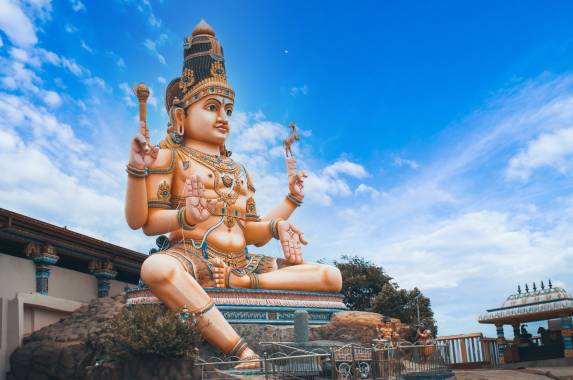
After lunch, we drive east to the coast and Trincomalee (approximately 2hr). Later, we visit Fort Frederick and the clifftop Thirukoneswaram Temple, an important Hindu pilgrimage site with views across the natural harbour, before settling into our beachside hotel.
Accommodation: Anantamaa Resort (or similar)
Choose coastal wildlife encounters around Trincomalee
The morning is free to enjoy Trincomalee’s shoreline or join an optional dolphin-watching trip (not included; approximately three hours, depending on sightings). These waters are known for being home to several dolphin species, with trips led by specialist crews.
In the afternoon, we travel (one hour) inland to Girihandu Seya, believed to be one of the earliest Buddhist stupas in Sri Lanka. Your tour leader explains its place in early Buddhist history before we return to the coast for a relaxed evening.
Accommodation: Anantamaa Resort (or similar)
Opt to snorkel the coral reefs off Pigeon Island • Uncover the ancient city of Anuradhapura

Those keen to explore below the surface can take an optional snorkelling trip to Pigeon Island (approximately 1hr 30min), where coral reefs support reef fish.
Later, we travel (2hr 10min) to Anuradhapura, Sri Lanka’s first capital and one of the great centres of ancient South Asian civilisation. As we explore the vast archaeological zone, our tour leader provides context for monumental structures such as Ruwanwelisaya, Jetavanarama and Abhayagiri, as well as the Sri Maha Bodhi, grown from a cutting of the tree under which the Buddha attained enlightenment and cared for here for more than 2,000 years.
We check into our hotel in the early evening.
Accommodation: Heritage Hotel or Lakeside Nuwara Wewa (or similar)
Ascend Mihintale • Optional safari in Wilpattu

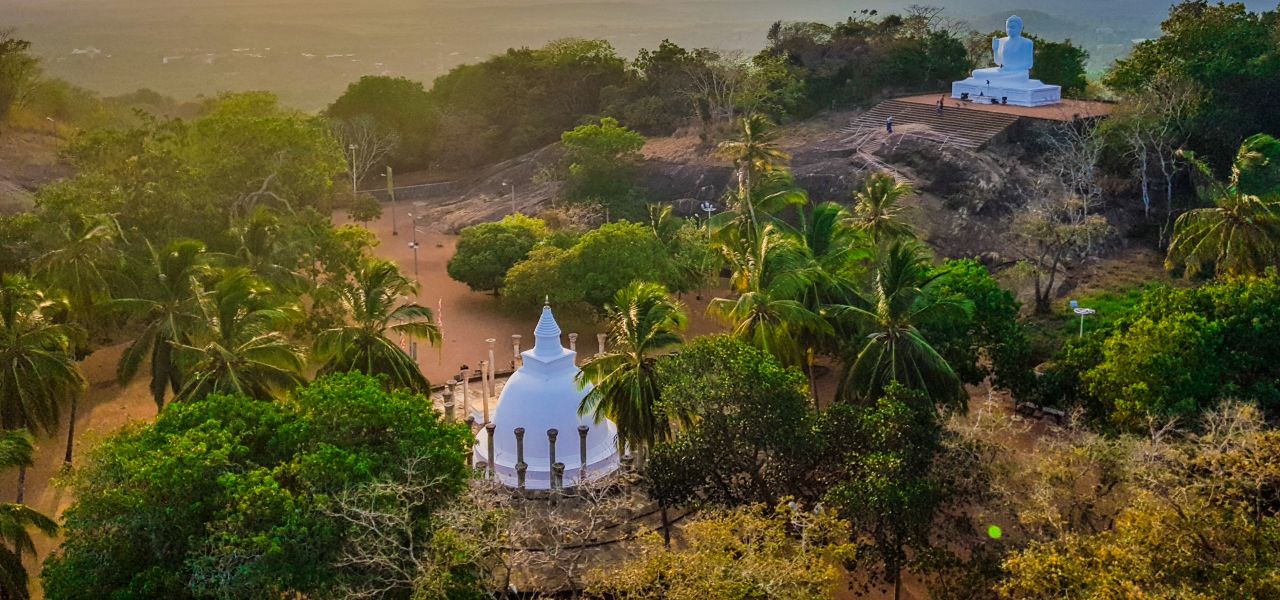
Visit Mihintale after breakfast, reached by a 25-minute drive. Often regarded as the birthplace of Buddhism in Sri Lanka, the site spreads across a series of granite hills topped with stupas, monasteries and viewpoints. Climbing the stone steps rewards us with wide views over the surrounding countryside and a deeper understanding of the island’s religious foundations.
In the afternoon, there is an optional game drive in Wilpattu National Park (approximately four hours). Known for its natural lakes and quieter atmosphere, Wilpattu is home to leopards, sloth bears and a wide range of birdlife.
Accommodation: Heritage Hotel or Lakeside Nuwara Wewa (or similar)
Travel north to Jaffna and visit major temples

We travel (approximately 3hr 30min) north to Jaffna, a region with a distinct cultural identity shaped by Hindu traditions and colonial history. After checking into our hotel, we explore Jaffna city, beginning with the impressive Jaffna Fort, originally built by the Portuguese and later expanded by the Dutch into a star-shaped stronghold.
We also visit Nallur Kandasamy Kovil, Sri Lanka’s most important Hindu temple dedicated to Murugan. Our tour leader explains temple customs and symbolism as we walk through richly decorated corridors framed by carved pillars and shrines.
Accommodation: Fox Jaffna (or similar)
Cross by ferry to Delft and Nagadeepa islands
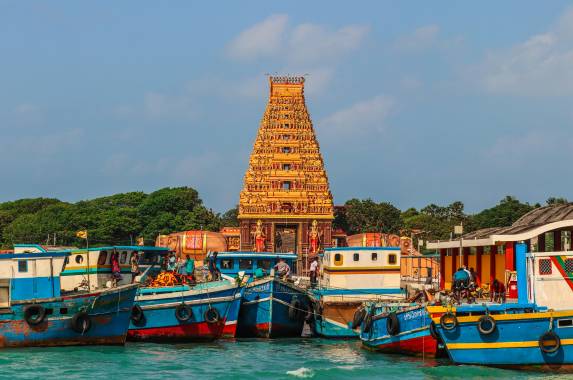
Today, we travel (45 minutes) to the coast and take a ferry (60-75 minutes) to Delft Island. The island’s coral-stone walls, colonial ruins and population of wild ponies give it a character unlike anywhere else in Sri Lanka. We also see ancient baobab trees, thought to have been brought here by early traders.
We then continue to Nagadeepa, an important Buddhist pilgrimage site associated with the Buddha’s second visit to Sri Lanka. Reached by boat, the temple complex sits low above the sea, creating a calm and contemplative setting before we return to Jaffna later in the day.
Accommodation: Fox Jaffna (or similar)
Discover the heritage and landscapes of Jaffna
Spend the day exploring Jaffna’s key cultural sites, including Jaffna Public Library, once one of the largest libraries in Asia, and the Archaeological Museum, which provides context for the region’s layered history.
We also visit Nilavarai, a natural freshwater well fed by underground springs, and Dambakola Patuna, traditionally believed to be the landing site of the sacred Bodhi sapling brought from India.
The evening is free to relax back at the hotel or take a final stroll through town.
Accommodation: Fox Jaffna (or similar)
Ride the rails south to Colombo
After breakfast and a relaxed start to the day, we board a first-class intercity train for the journey back to Colombo. The route south offers a chance to watch the island’s landscapes change from the northern plains to busier urban centres.
Depending on timetables, the train journey takes around six to eight hours. We arrive into Colombo in the evening and transfer to our hotel.
Following damage by Cyclone Ditwah in December 2025, Sri Lanka’s railways are not currently fully operational. If this is still the case by the time of your trip, this journey may be by road.
Accommodation: Ramada Colombo (or similar)
Adventure ends in Colombo
You’ve climbed the Sigiriya rock fortress, tracked elephants in the natural habitat, traced Sri Lanka’s Buddhist roots, and experienced the distinct culture of the island’s north – but now it’s time to begin your return journey home.
Alternatively, if you’d like to extend your adventure, speak to your sales representative to discuss our range of extension options, including time on Sri Lanka’s coast or a stay in the Maldives.
Post-trip Extensions
Sri Lanka Beach Hotels
Recharge with a few relaxing nights by the beach and make your Sri Lankan adventure feel even more extraordinary. Think warm waves, swaying palms, and fresh seafood enjoyed with a coastal breeze. Here are a few of our favourite beach hotels to inspire your stay:
Jetwing Lighthouse, Galle: An iconic hotel celebrated for its unique architectural heritage near the historic trading post of Galle. Perched on a rocky headland with rooms overlooking the Indian Ocean, Jetwing Lighthouse offers exceptional service, multiple pools and elegant dining.
Heritance Ahungalla: Set in a tranquil coastal location, this five-star resort blends beachfront luxury with sweeping ocean views. Its prime position on a long stretch of sandy beach makes it perfect for travellers looking to unwind and soak up Sri Lanka’s natural beauty.
Jetwing Beach Hotel, Negombo: A stylish and comfortable base with direct access to Negombo’s golden sands and a beachfront pool. Spacious rooms, excellent dining and close proximity to the airport make it an ideal choice for unwinding before your journey home.
This is just a glimpse of what’s possible. Speak to your sales representative, who can guide you through the options and arrange everything for you.
Maldives Hotels
Why not end your adventure with a touch of luxury in the Maldives, just a one-hour flight from Sri Lanka?
Beautiful islands covered with tropical vegetation, surrounded by wide sandy beaches and azure waters. Spend your days diving, snorkelling or swimming in the warm, calm ocean. For an unforgettable stay pick an iconic Overwater Villa, where panoramic sea views and serene sunsets come as standard. With many properties offering all-inclusive options, the Maldives can offer an indulgent finale to your holiday. Here are a few of our favourites to inspire your stay:
Royal Island Resort, Baa Atoll: Set on a lush, palm-fringed island in a UNESCO Biosphere Reserve, this peaceful retreat is known for its excellent diving/snorkelling, serene beaches and relaxed, natural atmosphere.
Hotel Riu Atoll, Dhaalu Atoll: A modern, all-inclusive resort offering overwater suites, beachfront rooms and a selection of dining options on Maafushi island. With great snorkelling, it’s perfect for those who want convenience and activities.
Taj Coral Reef Resort, North Malé Atoll: A stylish boutique island retreat, renowned for its vibrant marine life and exceptional diving. With elegant villas and personalised service, it offers an intimate and luxurious escape.
This is just a glimpse of what’s possible. Speak to your sales representative, who can guide you through the options and arrange everything for you.
Accommodation

We aim to secure locally owned accommodation that is well located, offers good value for money, and plenty of comfort.
The typical hotels we use are on the daily itinerary but below are some of the standout hotels we use.
Sigiriya: Hotel Sigiriya (nights 2-3)
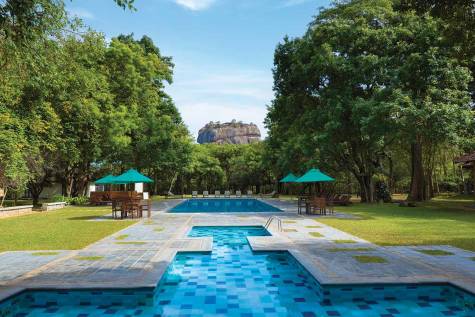
Swim with a view of one of Sri Lanka’s most remarkable landmarks at this relaxed retreat near Sigiriya Rock Fortress. The outdoor pool faces the towering rock itself, creating a memorable backdrop for a dip. Spacious rooms sit among leafy gardens, plus there’s a spa with ancient Ayurvedic treatments should you wish to treat yourself.
Jaffna: Fox Jaffna (nights 8-10)

Unwind in the one-time residence of a prominent local family, which today stands as one of the top boutique hotels in Jaffna. Explore the lush gardens, take a dip in the pool, and discover the preserved bunkers, now transformed into an art gallery and museum. If you really want to treat yourself, the in-house wellness retreat offers Ayurvedic therapies and traditional massages.
Colombo: Ramada Colombo (night 11)

Enjoy a stay in Sri Lanka’s vibrant capital at this contemporary hotel overlooking the Indian Ocean. Relax by the outdoor pool, sample a variety of dining options, and make the most of your central location, with many shopping, cultural and entertainment attractions within easy reach. Comfortable rooms and modern facilities make it a convenient base for exploring the city.
Worth knowing
- Tailor your trip: Extend your adventure by securing extra hotel nights before or after the main itinerary. Speak to your sales representative to book.
- Private rooms: Like most tour operators, we room solo passengers together. If you’d prefer to have a private room, it’s normally possible to do this for a supplement. Speak to your sales representative to book.
Single supplement from £ 555
Food & Drink
Allow around 9,000 Sri Lankan rupees (US$30) per day for lunches and dinners. Eating out is affordable, and your tour leader will recommend local restaurants, though some are not suitable for larger groups. In more remote areas, meals may be taken at the hotel, usually buffet-style, with limited à la carte options and slower service. Where possible, your leader can arrange transfers into town, or you may use a tuk tuk or taxi.
Sri Lankan cuisine centres on rice and curry, with meat and vegetable dishes flavoured by coconut and spices. Vegetarians are well catered for, but wheat- or dairy-free options are limited outside hotels, so please advise us in advance. Spicy food can usually be avoided, and Western dishes are often available.
Drinking water is provided throughout the trip in refillable containers; please bring a reusable bottle.
Transport
On this journey, we use a bus/minibus and train in first class (air conditioned).
Weather & Seasonality
This trip runs from May to early October, when the north and east of Sri Lanka are at their most settled. Expect warm days, lower humidity and clearer skies around Jaffna and Trincomalee.
Joining Instructions
Key information
Start hotel: The Covanro, 323 Airport Road, Naiwala Roundabout, Veyangoda 11100
Phone: +94 332 245 000
Recommended arrival time: You can arrive at any time today. There will be a welcome briefing around 6pm in the evening.
Airport: Bandaranaike International Airport (CMB)
Getting to the start hotel
The start hotel is approximately 30 minutes’ drive from the airport. We provide one group transfer from the airport to the hotel, which you can join at no extra cost, provided you can be at the airport before the transfer leaves. Speak to your sales representative for the transfer times or to arrange a private transfer.
Catching your return flight
There’s one group transfer to the airport, which you can join at no extra cost. Please speak to your sales representative for the time of the transfer. If the group transfer does not suit your flight time, speak to your sales representative to arrange an alternative.
Full joining instructions including local emergency numbers will be sent to you as part of our Final Joining Instructions. If you do not receive these at least a week before departure, or require them earlier please contact our office or your travel agent.
Location start: Veyangoda
Location end: Colombo
What To Take
Essential Equipment
- Refillable water bottle (ideally with a wide mouth) – plastic bottles are a big issue in many countries where recycling isn’t yet widely available and we would like to reduce our impact here. Therefore, the leader can take a kitty and purchase five-litre bottles of water for the group, which is less wasteful than everyone purchasing smaller bottles individually
- Sunhat
- Sunscreen
- Light casual clothing
- Warm sweater/fleece
- Sandals (especially if you want to go rafting)
- Sports shoes/walking shoes
- Light waterproof
- Swimwear
- Hand gel
- Small personal first-aid kit
- Torch/flashlight
There is no strict dress code during the trip, you can wear whatever you feel comfortable in. However, when visiting temples, both men and women should cover their shoulders and wear clothing that covers the knees as a sign of respect. It doesn’t matter what type of bag or case you use on this trip. You should also bring a small backpack for your valuable items.
Practical Info & Visa
Visa
Sri Lanka
Travellers from the UK, US and EU normally need a visa (ETA) to enter Sri Lanka. Travellers from 40 countries, including the UK, US and Canada, can obtain a free 30-day ETA at www.eta.gov.lk. We strongly recommend that you do this prior to travel to avoid any complications and delays on arrival. Please note, visa requirements often change and it is your responsibility to obtain any required visas for this trip. Therefore, we recommend that you check with the nearest embassy or consulate of your chosen destination(s), including any countries you may be transiting or transferring through.
Some local governments provide guidance on what visas their citizens need. To help, we’ve gathered a selection of useful links below.
- Australia: www.smartraveller.gov.au/destinations/asia/sri-lanka
- Canada: www.travel.gc.ca/destinations/sri-lanka
- United Kingdom: www.gov.uk/foreign-travel-advice/sri-lanka/entry-requirements
- USA: www.travel.state.gov/content/travel/en/international-travel/International-Travel-Country-Information-Pages/SriLanka.html
Local customs and laws: You should be aware of local laws and customs in Sri Lanka (see: www.gov.uk/foreign-travel-advice/sri-lanka/local-laws-and-customs). The mistreatment of Buddhist images and artefacts is an offence; please note, people have been refused entry to Sri Lanka because of visible tattoos of Buddha.
Vaccinations and Health
Sri Lanka
There are no required vaccinations. However, recommended vaccinations include tetanus, hepatitis A, hepatitis B, Japanese encephalitis, rabies, tuberculosis and typhoid. You will also need a yellow fever vaccination certificate if you’re arriving from a country with risk of yellow fever transmission or transiting for more than 12 hours through a country with risk of yellow fever transmission. Please confirm with your doctor or travel clinic.
Dengue fever, a tropical viral disease spread by daytime biting mosquitoes, is a known risk in places visited. There is currently no vaccine or prophylaxis available; the best form of prevention is to take the usual precautions to avoid mosquito bites.
For detailed health and vaccination advice, visit:
- UK: The Travel Health Pro website
- US: The Centers for Disease Control and Prevention website
- Canada: The Canadian government’s travel health page
Local Time
Sri Lanka's time zone: Asia/Colombo (UTC +05:30)
Electricity
Sri Lanka's electricity:
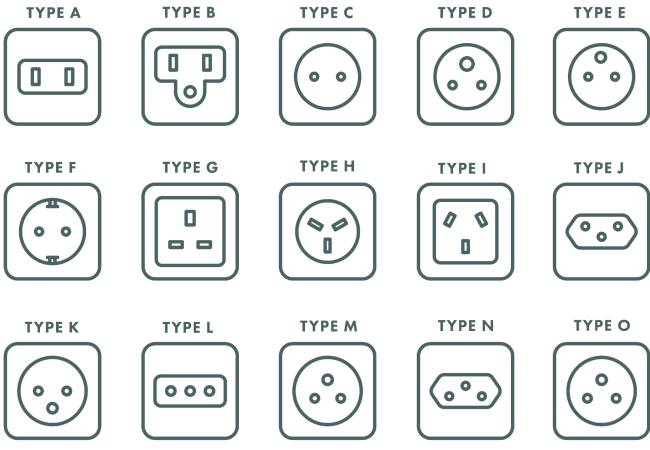
Plug type G (three rectangular pins) – 230V, 50Hz – is by far the most common type in Sri Lanka. The electricity supply is not 100 percent reliable but is usually only off for short periods
Money
Sri Lanka's currency: All foreign passport holders can make payments for purchases in the local currency, Sri Lankan rupees (LKR). This is applicable to hotels, restaurants, shops and for any other services. Credit cards (Visa, Mastercard and American Express) are widely accepted in hotels, restaurants, and most established shops. If you wish to exchange any cash upon arrival into Sri Lankan rupees, it is advisable to exchange British pounds, euros or US dollars upon arrival at Colombo Airport where authorised bank money exchanges are open 24-hours a day. Hotels can change money as well, but the rates will probably not be favourable. Your Tour Leader will be happy to direct you to the appropriate exchange services if you wish to change money during the trip. You are no longer required to produce your receipt of foreign exchange when making payments in Sri Lankan rupees, as was previously the case. However, we suggest you retain receipts of foreign exchange which will help should you wish to change back any unused rupees at the time of departure.
ATM Availability
You will find ATMs in many of the main towns in Sri Lanka with Visa, MasterCard and American Express widely accepted. There is often a 3%-4% fee on top of your withdrawals so bear that in mind.
It’s worth informing your bank before departure that you are travelling to Sri Lanka and carry the relevant telephone number with you in case they put a block on your card.
Extra Expenses & Spending Money
For small purchases, particularly at local shops and markets, cash is generally preferred and easier for transactions than credit cards.
It is recommended that you allow at least 2,200 Sri Lankan rupees (US$6) for personal expenditures such as stamps, postcards and soft drinks. Some sites may charge a small fee for camera use. Shopping opportunities in Sri Lanka are endless and we suggest you take money for souvenirs, even if you are generally not a keen shopper, we have found most people succumb to the wide variety of handicrafts on offer.
All entrance fees and activities described in the itinerary are included with an exception for the optional activities mentioned on some days.
Optional excursions
- Wilpattu game drive: Approximately 27,000 rupees (US$90) per person based on a minimum of four people
- Snorkelling in Trincomalee: Approximately 27,000 rupees (US$90) per person based on a minimum of six people
- Dolphin watching in Trincomalee: Approximately 17,000 rupees (US$55) per person based on a minimum of six people
Tipping
Tipping is part of the culture in Sri Lanka.
Tipping kitty: Tipping can be an awkward affair, especially when you’re in an unfamiliar country. As such, your tour leader will offer to arrange and look after a tipping kitty, which will be used to tip hotel staff, local guides, and other support staff used on the trip (optional excursions are not included in the group kitty). Your tour leader will suggest how much to contribute, but it is usually about 16,500 rupees (approximately US$50) per group member. At any time during the trip, your tour leader will happily show you an account of how the kitty is being distributed.
Tour leader and transfer crew: These are not included in the tipping kitty and are at your own discretion. If you wish to show your appreciation, our recommendation is as follows:
- Driver and assistant: around 650-950 rupees (US$2-US$3) per group member, per day
- Tour leader: around 1,100-1,600 rupees (US$4-US$5) per group member, per day
Where possible, please try to tip in the local currency.
Sustainability and Impact
As a certified B Corp, we’re on a mission to improve our social and environmental impact across all our adventures.
We do this through our innovative Thriving Nature, Thriving People plan.
This ‘nature positive’ approach is designed to help nature and communities thrive in harmony through practical solutions, such as reducing carbon and waste on our trips, supporting conservation projects through the Exodus Adventure Travels Foundation, and rewilding 100 square metres for every Exodus traveller.
You’ll also find Thriving Nature, Thriving People moments across our trips. These experiences are often a highlight of your adventure, while also benefiting the natural world or local communities.
On this trip, we:
- Enjoy a warm welcome into a farmer’s home for a traditional Sri Lankan lunch, prepared using local ingredients and family recipes – a relaxed and personal way to understand daily life beyond the historic sites.
Important Information
Your Safe Participation
When booking this trip, you should be confident in your ability to participate in all activities described in these Trip Notes. If you have any doubt about your suitability, please call us and ask to speak to one of the experts on this itinerary.
Although our leaders are well trained to deal with different capabilities, if they have any concerns about someone’s ability to safely take part in an activity, or their impact on other people’s enjoyment, we authorise them to take necessary action which, in some circumstances, may involve asking someone to miss that activity.
By booking this trip you agree to our Booking Conditions which clearly state that our leaders have the authority to do this. In these rare instances we will ensure anyone sitting out is safely provided for and offered alternative options where possible. Refunds will not be provided for activities missed and customers may be liable for additional costs incurred.
Seatbelts
All vehicles used by us should be equipped with working seatbelts, except where approved by us based on the vehicle type or journey. Wherever seatbelts are available, we require our customers to use them for their own safety, even where it may not be a legal requirement.
Travel Safety
For additional information please have a look at the travel safety advice page on our website.
How To Book
Speak to our friendly team of experts to plan your adventure:
- Check availability: our website shows real-time availability of our guided group tours, or contact our team by phone, email or live chat.
- Hold a space: You can provisionally hold a space on any guided group tour to give you time to finalise your travel plans.
- Confirm your booking: Payment of a deposit will complete your booking and secure your place on the trip.
After booking
You will receive a confirmation document and invoice, which includes extra information and guidance about your travel arrangements. Our dedicated Customer Operations team will help you with any pre-travel questions or arrangements and can easily add extensions or extra accommodation to your booking. Final Joining Instructions will usually be sent out two to three weeks prior to departure.
Adding transfers to your booking
If you have arranged your own flights and would like to add transfers to your booking, please provide your arrival and departure details to our Customer Operations team around four to six weeks before departure.
- Where complimentary transfers are included, they are available for any flight but can only be added to your booking once we have received your flight schedule.
- Where group arrival and departure transfers are available, these operate at fixed times. You will need to arrive in time to meet the scheduled transfer. If the timings don’t align with your travel plans, our team can arrange private transfers once they receive your flight schedule.
Trip Note validity
Trip notes may be updated after booking; if any updates significantly impact the inclusions or itinerary you will be advised in writing. A link to the most up-to-date Trip Notes will be sent out with your Final Joining Instructions before departure.
The information in these Trip Notes is given in good faith. All holidays can be subject to unexpected changes, and occasionally it may not be possible to follow the itinerary as planned. In these circumstances we will make the best-possible alternative arrangements that maintain the integrity of the original itinerary.
